When I first joined the industrial cleaning equipment industry more than a few years ago, I didn’t fully understand why some floor cleaning machines lasted ten years, while others barely survived one. But after working closely with R&D teams, visiting factories around the world, and helping hundreds of distributors choose the right machines, one thing became crystal clear:
👉 The true quality of an industrial floor cleaning machine is determined long before it reaches the production line.
It begins in R&D and engineering design.
Today, I want to share what I’ve learned—from real failures, real projects, and real engineering battles—so that you, as an international buyer, distributor, or OEM partner, can instantly recognize whether a manufacturer is truly professional.

1. Why R&D Matters More Than Anything Else
If you’ve ever managed cleaning equipment for factories, warehouses, or commercial buildings, you already know the frustration:
- Machines that overheat
- Motors that burn out
- Brushes that lose torque on rough floors
- Water tanks that crack
- Batteries that fail after a few months
- Sensors that malfunction in humid environments
Whenever clients ask me, “Why are industrial machines more expensive?”
I always give the same answer:
👉 Because industrial machines are engineered to survive workloads that commercial machines simply cannot handle.
A commercial scrubber is designed to clean a supermarket.
An industrial machine must withstand concrete dust, oils, metal debris, 10+ hours of daily operation, and operators who don’t treat machines gently.
Without strong R&D engineering, industrial cleaning machines fail fast.
With it, they become long-lasting, reliable assets that save customers money.

2. R&D & Engineering: Where Quality Actually Begins
As a professional floor cleaning machine manufacturer, our engineering team spends months—sometimes years—refining every detail before the first sample is built.
Let me walk you through the parts of engineering that buyers rarely see, but should absolutely care about.
2.1 Structural Design & Strength Simulation
Before any mold is made, our engineers run:
- CAD structural optimization
- Finite Element Analysis (FEA)
- Torque and impact simulations
- Bottom chassis stress tests
Why does this matter?
Because in industrial environments, even a small design flaw becomes a big problem.
I once visited a facility that bought cheaper commercial machines. The chassis cracked after just five weeks because the motor mount wasn’t reinforced. When we showed them the structural simulation of our industrial model, they immediately understood the difference.
👉 Industrial design isn’t guesswork—it’s engineering.
2.2 Motor Power Calculations & Torque Modeling
A commercial machine motor is often rated for 400–500 hours.
But industrial-use machines typically require 1500–3000 hours of motor life.
Our engineers calculate:
- Required torque for oily concrete floors
- Brush pressure under full load
- Cooling performance during long shifts
- True motor efficiency curves
This is why an industrial motor costs more—
not because it’s “bigger,” but because it’s designed to last.
2.3 Waterproofing Engineering (IPX4–IPX6)
People underestimate how much water, detergent, humidity, and dust affect electronics.
Industrial machines use:
- Sealed connectors
- Coated PCBs
- IPX-rated enclosures
- Silicone-filled cable interfaces
Commercial machines rarely do.
I personally tested a competitor’s PCB that claimed “waterproof.”
It failed in 15 minutes during our humidity chamber test.
👉 When choosing a manufacturer, always ask how their PCBs are protected.
2.4 Battery Engineering & Safety
Many clients ask:
“Is lithium better or lead-acid?”
The real answer depends on R&D engineering:
- BMS design
- Battery cooling
- Current draw calculations
- Overload protection
- Charger compatibility
For example, your machine uses 24V 103Ah batteries. The engineering behind current draw and heat management determines whether your battery lasts 300 cycles or 700+ cycles.
Battery engineering is not optional—it’s a safety requirement.

3. Water Tanks & Mold Manufacturing: The Hidden Quality Divider
I’ve toured dozens of floor cleaning machine factories, and one thing always reveals the difference between commercial and industrial quality:
👉 The water tanks.
3.1 Rotational Molding vs Injection Molding
- Rotational molding → Thick walls, high strength, ideal for industrial use
- Injection molding → Cheaper, thinner, more suitable for light-duty commercial machines
Industrial tanks must survive:
- Impacts
- Chemical cleaners
- Heat
- Vibration
- Full-capacity pressure
This is why we design:
- 6–8 mm wall thickness
- Anti-crack rib structures
- Drop-test validated prototypes
- Explosion-pressure tests for large tanks
Commercial suppliers rarely test tanks beyond basic leakage.
3.2 Metal Chassis & Weld Quality
Industrial sweepers require:
- Steel chassis
- Robotic welding
- Anti-corrosion coatings
- Vibration-resistant mount points
A weak weld or thin steel plate guarantees long-term failure.
I’ve seen commercial sweepers where the brush motor mount bent after two months.
Our industrial machines use 3–5 mm steel for structural components, and that makes all the difference.

4. Raw Materials & Components: Where Cheap Machines Compromise
Let’s break down the parts that matter most:
4.1 Industrial Motor vs Commercial Motor
- Commercial: 400–500 hours
- Industrial: 1500–3000 hours
- Brushless options: 5000+ hours
4.2 Industrial Wheels & Rubber
- Oil-resistant
- Heat-resistant
- Anti-wear compounds
Commercial-grade wheels flatten quickly under load.
4.3 Gearbox & Transmission
Industrial machines use:
- Metal gears
- Sealed lubrication
- Heavy-duty bearings
This ensures stable torque even under pressure.
4.4 Electrical Connectors
We use:
- Waterproof automotive-grade connectors
- Shielded signal cables
- IPX-rated plugs
Commercial machines usually use simple snap-on connectors.
5. Assembly & Production: Where Reliability Is Built
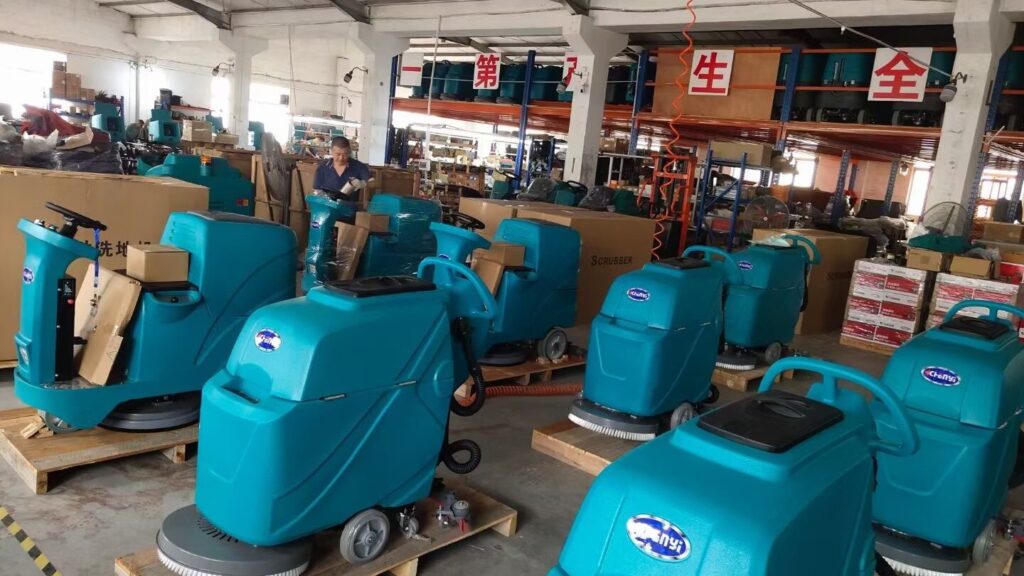
Inside our floor cleaning machine factory, the production line looks more like an automotive workshop than a typical appliance plant.
Here’s what professional production actually means:
5.1 Precision Assembly Tools
- Torque-controlled screwdrivers
- Dedicated jigs and fixtures
- Calibration instruments
5.2 Quality Traceability
Every machine receives:
- Serial number traceability
- Motor testing data
- PCB inspection records
- Battery performance logs
If a distributor ever faces an issue, we can trace back to the exact process step.
5.3 Aging Tests
Commercial machines may run for 10 minutes for testing.
Industrial machines undergo:
- 48-hour aging
- Brush pressure validation
- Noise & vibration tests
- Battery load simulations
This is how you prevent early failures.
6. Real Application Scenarios: Why R&D Engineering Matters in Daily Use
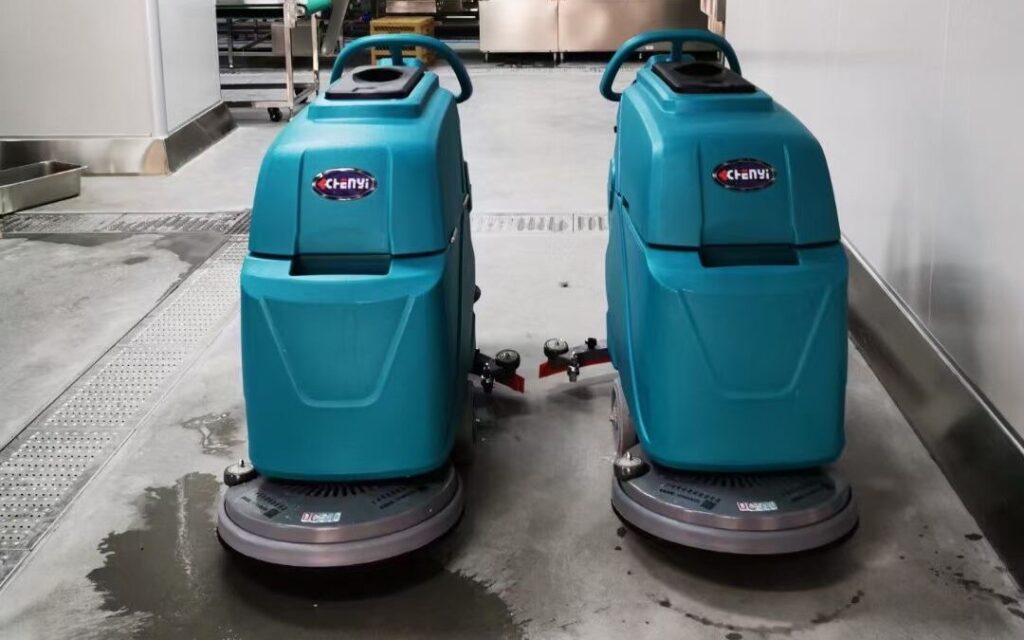
After supplying machines to warehouses, factories, airports, schools, and hospitals, I’ve seen the difference engineering makes.
Factories
- Oils, dust, and long shifts destroy weak motors.
- Industrial torque and cooling keep performance stable.
Warehouses
- Operators often hit pallets and walls.
- Reinforced tanks and steel chassis survive impacts.
Supermarkets
- Need quiet, efficient cleaning.
- Precision engineering ensures low noise and smooth operation.
Parking Lots
- Uneven floors demand strong brush pressure.
- Industrial gearboxes and motors prevent torque loss.
These aren’t “features”—they’re engineering outcomes.

7. How to Choose the Right Manufacturer (From Someone Who Has Seen the Truth)
If you’re evaluating a floor cleaning machine manufacturer, look for:
1. In-house R&D team
Not outsourced engineers.
2. Mold design & industrial structure capability
A serious manufacturer builds their own molds or manages them professionally.
3. Real industrial testing standards
Drop tests, load tests, aging tests.
4. OEM/ODM capability
If you plan long-term cooperation, choose a partner who can customize, innovate, and scale.
5. Transparent factory processes
If they don’t want you to see production—run.
When you find a partner who meets these criteria, the quality difference becomes obvious from day one.
8. FAQ (Google SEO-Optimized)
Q1: Why are industrial floor scrubbers more expensive?
Because industrial machines require stronger motors, reinforced structures, thicker tanks, better waterproofing, and higher engineering standards.
Q2: How long does an industrial machine last?
Typically 5–10 years with proper maintenance, compared to 1–3 years for commercial machines.
Q3: Can a commercial scrubber be used in a warehouse?
Usually no. Warehouses require high torque, long runtime, and stronger structure.
Q4: What makes a manufacturer professional?
Strong R&D, quality testing, industrial materials, and OEM/ODM capabilities.
Final Thoughts: Engineering Is Not a Cost — It’s a Long-Term Investment
You and I both know that industrial machines are not bought for “today.”
They’re bought for 5–10 years of daily work.
As someone deeply involved in this industry, I’ve learned that:
👉 The best machines come from manufacturers who invest heavily in R&D, engineering analysis, material science, and structured production.
If you are choosing a supplier, your goal isn’t just to find a machine—
it’s to find a partner who understands engineering and can support your growth for years to come.
And that’s exactly what we aim to provide.